
How to Get a Section 27 Statement Signed — and When It’s Safe to Release the Deposit
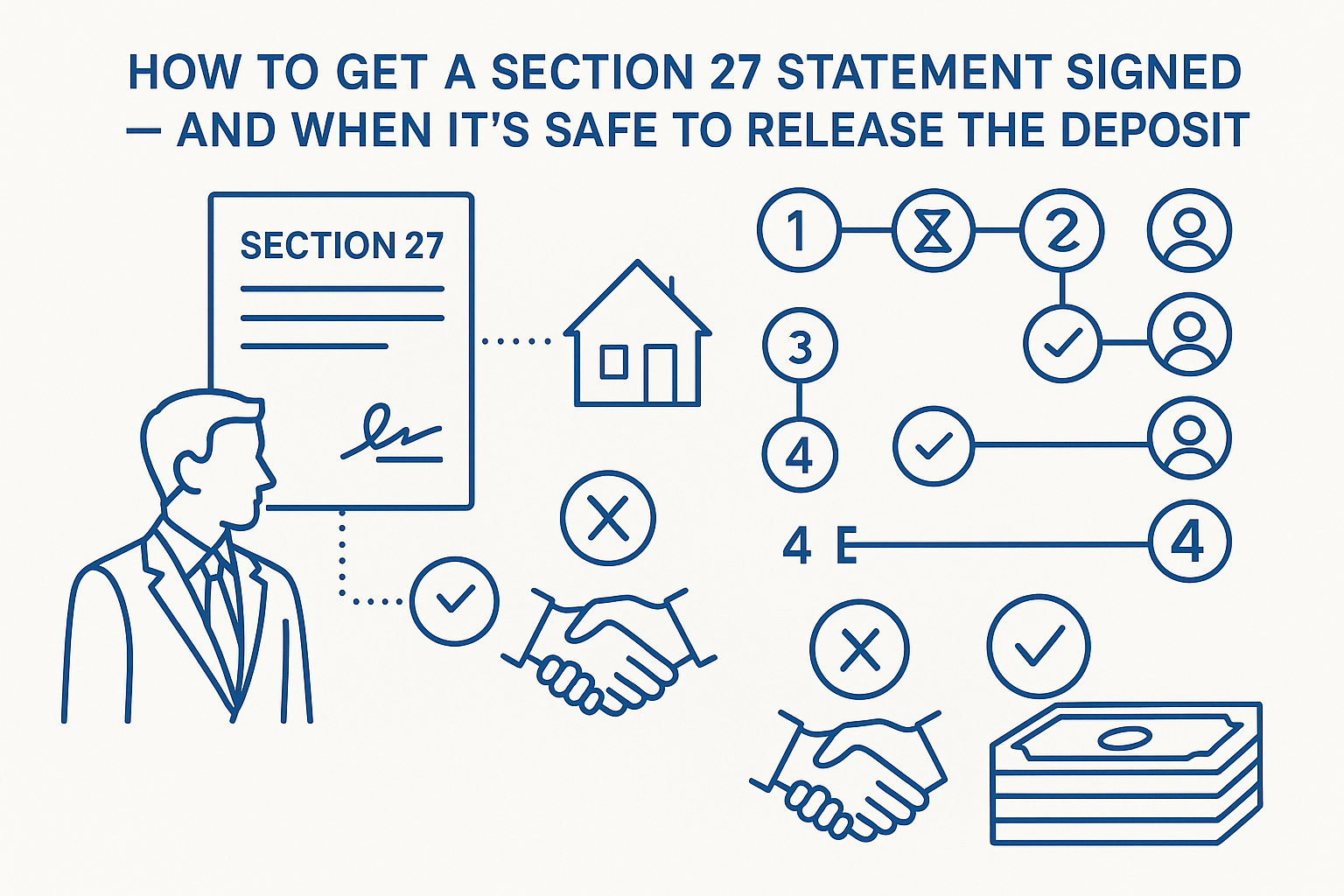
If you are selling a property in Victoria, one of the first questions you will usually ask is whether you can have early access to the buyer’s deposit. The only lawful way to do this is through a Section 27 Statement, which comes from Section 27 of the Sale of Land Act 1962 (Vic).
This document allows a vendor to request the release of the deposit before settlement, but only when very strict legal conditions are met. Below is a clear guide on how to get a Section 27 Statement signed and when it is actually safe to release the deposit.
What a Section 27 Statement Really Is
A Section 27 Statement is a formal written notice that sets out the financial position of the property being sold.
It tells the purchaser:
• Whether the property is mortgaged
• Who the lender is
• How much is owed
• Whether there are any caveats or other interests on title
Under Section 27, the purchaser must be given this information so they can decide whether it is safe for them to agree to an early release. The whole purpose is to ensure the purchaser will still receive clear title at settlement.
The Legal Requirements
For a deposit to be released early, all of the following must be satisfied under the Sale of Land Act 1962 (Vic):
The contract must be unconditional.
A contract subject to finance, building, pest or any other purchaser condition cannot support an early release until those conditions are formally satisfied or waived.The purchaser must have accepted the title.
The purchaser or their representative must confirm that the title and the disclosures under the Section 32 are satisfactory.The vendor must give a complete Section 27 Statement.
This must disclose any mortgage, any caveat, and must be supported by written confirmation from the lender showing the current payout figure.There must be enough equity.
If the amount owed on the mortgage is more than 80 percent of the purchase price, the purchaser has a statutory right to object. A high loan balance is treated as a red-flag, because the sale proceeds may not be enough to discharge the mortgage.The purchaser must consent — or remain silent for 28 days.
The purchaser may agree in writing to release the deposit at any time.
If they do not agree, they are given 28 days to object.
If they do nothing for 28 days, the law treats this as consent.
How to Get a Section 27 Statement Signed (Step-By-Step)
Step 1: Wait until the contract is unconditional
If the property was sold at auction, it is unconditional immediately.
If sold privately, wait for the purchaser’s conditions to be satisfied.
Step 2: Ask your conveyancer to prepare the Section 27 package
You will need to provide your loan account details so your lender can issue an up-to-date payout figure.
This payout letter is critical — without it, most purchasers will object immediately.
Step 3: Sign the Section 27 Statement
Your conveyancer will prepare the form. Check that the loan figure is accurate.
Giving false information to a purchaser is an offence under the Act.
Step 4: Serve the statement on the purchaser
Once the purchaser or their representative receives it, the 28-day clock begins.
Step 5: Purchaser reviews the information
They may ask questions, request further supporting documents, or simply choose to wait.
If they are satisfied, they may sign immediately. If not, they may object.
Step 6: If the purchaser signs, the deposit can be released
This is the fastest pathway. Once signed consent is received, the stakeholder can release the funds (after deducting the agent’s commission if applicable).
Step 7: If the purchaser objects, the deposit stays in trust
A valid objection stops the early release permanently. The deposit is then held until settlement.
Step 8: If 28 days pass with no objection, the deposit may be released
Silence for 28 days equals deemed consent under the Sale of Land Act.
Common Buyer Objections
Even where technically allowed, many purchasers choose not to release the deposit early.
Typical objections include:
• Mortgage over 80 percent of the price
• No payout letter provided
• An existing caveat on title
• General caution or lender instructions to keep the deposit in trust
All of these are legitimate reasons for a purchaser to object and cannot be overridden.
When It’s Actually Safe to Release the Deposit
A deposit is only safe to release when:
• The contract is unconditional
• A complete Section 27 Statement has been served
• The purchaser has either signed consent
• Or 28 days have elapsed without objection
Only then does the Sale of Land Act allow the stakeholder to transfer the funds to the vendor.
Do not treat the deposit as available money until one of those two events has occurred.
Risks for Sellers to Be Aware Of
Selling while relying on early release can be risky. Key risks include:
• Spending the deposit before settlement and later facing delays
• High mortgage balances making release impossible
• Relying on invalid contract clauses attempting to force early release
• Not having enough funds available at settlement if the deposit was used prematurely
The safest approach is to view early release as a bonus, not something to depend on. Some sales will allow it easily. Others will not.
A Typical Scenario
A clean, low-risk Section 27 release:
The seller has a very small mortgage. The sale is unconditional. The payout letter shows plenty of equity. The purchaser signs after a few days and the deposit is released with no issue.
A high-risk Section 27 refusal:
The seller owes more than 80 percent of the sale price. The purchaser’s representative objects immediately based on the mortgage level. The deposit stays in trust until settlement — the seller must plan without it.