

The Next 10 Melbourne Suburbs Set to Boom (2025–2027)
/
Melbourne’s property market is entering a new growth phase, and savvy investors are eyeing the next wave of undervalued suburbs poised to boom. In the next 2–3 years, areas with strong transport links, major infrastructure projects, and surging rental demand are expected to see significant capital growth. This report highlights 10 Melbourne metropolitan suburbs – from the fast-changing inner-west to the emerging outer southeast – that have not yet experienced explosive price growth but show all the signs of being the next property hotspots. Each suburb is backed by improving connectivity or amenities (new rail lines, road upgrades, hospitals or schools) and tightening rental markets, creating ideal conditions for capital gains. Investors who get in early on these suburbs could benefit from rising values as Melbourne’s population and economy continue to expand. (Looking to secure your next investment property? Victorian Property Settlements offers trusted conveyancing to make your purchase seamless.)
Why These Suburbs Are Poised for Growth
Melbourne’s overall outlook for 2025–2027 is very optimistic. After a mild dip, property values are rebounding, and experts predict Melbourne will lead the nation in price growth over the next two year. Several factors are driving this surge: record population growth, especially from overseas migration, is fueling housing demand and pushing rents to record highs Meanwhile, the Victorian government’s huge infrastructure pipeline – over $10 billion in transport projects – is transforming connectivity in many middle and outer suburbs New train lines, freeway upgrades and development initiatives are unlocking the potential of areas previously overlooked. Investors are returning to the market, drawn by affordable prices in these growth corridors and improving buyer confidence. Below we dive into ten Melbourne suburbs that stand out for their strategic location, upcoming infrastructure, and strong rental appeal – making them prime candidates for the next property boom.
1. Sunshine – The Emerging Transport Superhub
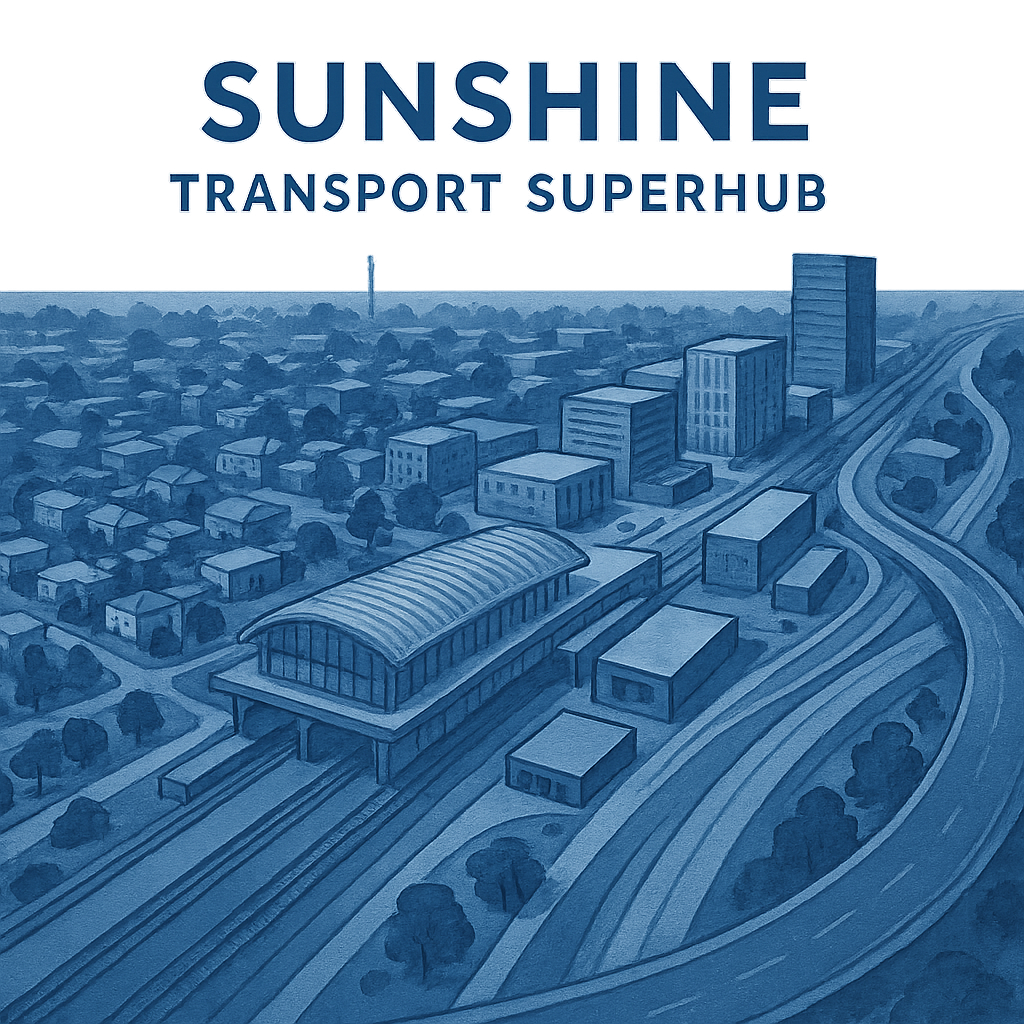
Sunshine’s upgraded train station precinct is set to become a major transport superhub, linking suburban rail lines and the future airport train.
Sunshine, located just 12 km west of the CBD, is undervalued relative to its location and is on the cusp of major change. The suburb will benefit enormously from government infrastructure investment – notably the planned Sunshine Station “Super Hub” as part of the Melbourne Airport Rail link and the future Suburban Rail Loop. These projects will effectively turn Sunshine into a major transport and jobs hub, drastically improving connectivity. The area is also undergoing gentrification, with former industrial sites being rezoned to residential and new developments springing up. Sunshine’s median house price (around $750,000) remains relatively affordable for a middle-ring suburb. With its excellent train access, growing town centre, and proximity to the CBD, Sunshine is Greater Melbourne’s rising star. Experts note that government projects like the Sunshine Super Hub and Airport Rail are “transforming the suburb,” laying the groundwork for long-term capital growth. As buyers priced out of inner suburbs look west, Sunshine is well positioned to boom.
2. Frankston – Bayside Affordability Meets Infrastructure
Frankston has long been a sleeper suburb by the bay, but it is now rapidly emerging as a growth hub. Located on Port Phillip Bay about 40 km south of the CBD, Frankston offers a coastal lifestyle with a median house price around $750,000 – far cheaper than inner bayside suburbs. This affordability, combined with recent gentrification, is driving strong demand from buyers priced out of suburbs like Mordialloc and Cheltenham. Frankston also boasts solid infrastructure: it’s a terminus of the metropolitan train line, has a major hospital and educational precinct, and serves as a regional activity centre. Crucially, future transport plans will further boost Frankston. It’s earmarked for a new Suburban Rail Loop station in the long-term rail network, which would improve connectivity to other outer suburbs. The state government is also investing in the local precinct (including a $562 million Frankston Hospital redevelopment). According to market analysts, “Frankston is Greater Melbourne’s rising star. It’s got the infrastructure and energy to support long-term growth.” Major high-rise apartment projects have been approved, signaling developer confidence. With its beachfront appeal, transport links and ongoing upgrades, Frankston is expected to attract more young families and investors, pushing up property values over the next few years.
3. Werribee – Growth Corridor with New Connectivity
Werribee, roughly 32 km south-west of Melbourne’s centre, sits in one of Victoria’s fastest-growing corridors. For years it’s been an affordable family suburb, and now several factors are converging to make Werribee a likely boomtown. Transport improvements are a big driver: the new West Gate Tunnel (due ~2025) will cut travel times from Werribee to the CBD by up to 20 minutes, greatly improving commuter access. Werribee already has a V/Line train service, and longer-term plans could see metro rail extending to Wyndham. Within the suburb, incremental infrastructure upgrades – like better walking/cycling trails and revitalized public spaces – are enhancing liveability. The local economy is expanding too, with the East Werribee employment precinct (a planned business park and university campus) and existing attractions like Werribee Zoo boosting jobs. Population growth in the City of Wyndham was 4.2% in 2024, among the highest in Australia, translating to high housing demand. According to property data, Werribee’s median house price is still around $620,000, but investor interest is rising alongside rents (houses yield ~4.2%). In fact, Werribee is often highlighted as a top value pick in Melbourne’s west, offering affordability and strong growth potential. As the new freeway opens and amenities continue developing, Werribee is set to shed its sleeper status – investors anticipate significant capital gains here in the next 2–3 years.
4. Melton – Affordable Frontier with Big Plans
Melton, a suburban town 35 km west of Melbourne, remains one of the city’s most affordable housing markets – but perhaps not for long. It’s one of the few areas where median house prices are still around the mid-$400k range, making it a magnet for first-home buyers and value-seeking investors. Crucially, Melton is part of Melbourne’s Western Growth Corridor, earmarked in state planning for significant expansion of housing, jobs and transport infrastructure. The Victorian government has announced plans to electrify and upgrade the rail line to Melton, integrating it into the metro train network in coming years (drastically improving commute options). Major developers are also moving in with master-planned communities and new town centre facilities. According to the Australian Bureau of Statistics, Melton’s property values are projected to rise around 5% annually, driven by its mix of affordability and planned infrastructure investment. Already, new highway interchanges and the nearby West Gate Tunnel are improving road connectivity for Melton residents. Local agents report that buyer interest is surging: Melton has consistently been Melbourne’s cheapest suburb, but increasing demand from across the west and even interstate investors means it won’t remain a bargain for much longer. As one long-time Melton agent observed, “When I started 18 years ago homes were under $200k… it’s still the cheapest area, but that’s changing fast”. With rapid population growth on its fringe and government attention, Melton is poised for a breakout. Investors who purchase now can secure a high land-to-price ratio and potentially reap strong capital growth as the suburb matures.
5. Cranbourne – Growth Hub of the Southeast
In Melbourne’s outer south-east, Cranbourne is booming with new development yet remains relatively affordable, making it a prime pick for future growth. This suburb (around 43 km from the CBD) sits in the heart of the Casey growth corridor and has seen massive influx of young families. Significant infrastructure projects are underway in Cranbourne, including transport upgrades and new community facilities. The Cranbourne rail line is being duplicated and extended to improve train frequency, with a future rail extension to Clyde on the horizon Road projects and the impending upgrade of the Monash Freeway and South Gippsland Highway are also set to cut travel times. Within the suburb, new shopping centres, schools and even health facilities are opening as the population expands. These investments have enhanced Cranbourne’s appeal and “pave the way for future growth”. The rental market in Cranbourne is extremely tight, with vacancy rates near zero and rents climbing rapidly. Landlords are enjoying higher yields thanks to this demand, and would-be renters are turning into buyers – putting upward pressure on prices. Property experts note that Cranbourne’s affordable entry point (median house prices still below the city average) plus its ongoing infrastructure boom make it an ideal spot for capital growth. The suburb’s family-friendly amenities (parks, schools, shopping) and connectivity – easy access to major arterials and the rail to Melbourne – are attracting a steady stream of new residents. With limited housing supply relative to demand, Cranbourne’s property values are forecast to trend up solidly over the next few years. For investors seeking strong rental returns and capital upside in Melbourne’s southeast, Cranbourne is a standout contender.
6. Reservoir – Gentrifying North with Rising Rents
Reservoir in Melbourne’s north is a classic case of a once-overlooked suburb now coming into its own. Located 12 km north of the CBD, Reservoir for decades lagged behind its trendy neighbors Preston and Thornbury – but that’s rapidly changing. Improved transport and rezoning have been catalysts. The recent level-crossing removals delivered a modern new Reservoir train station and better local connectivity, while the extension of the Route 86 tram to the nearby Plenty Road corridor has significantly improved CBD access. These upgrades, along with new cafes and shops catering to younger residents, have spurred gentrification in Reservoir. The suburb still offers many post-war family homes on large blocks as redevelopment opportunities, at prices well below suburbs just a few kilometres closer to the city. In fact, Reservoir’s housing remains more affordable than Preston (median house price around $900k vs. Preston’s ~$1M+), which is attracting both first-home buyers and investors looking for value. Rental demand is surging here as well. In the past year, Reservoir’s rental yields jumped over 5%, reflecting tight vacancies and higher rents – a trend attributed to the suburb’s ongoing gentrification and improved transport links. The Victorian government has also identified Reservoir for revitalisation funding, partnering with community groups to improve public spaces and safety. All these factors align with Melbourne’s “20-minute neighbourhood” plan, which aims to ensure residents can access most daily needs locally – something Reservoir is increasingly able to offer. As one property advisor noted, Reservoir shows how strategic urban planning can unlock untapped potential in middle-ring suburbs. With momentum building, Reservoir’s trajectory is clearly upward – making it a compelling investment hotspot in the north.
7. Broadmeadows – Reinvention of an Affordable Inner-North Suburb
Broadmeadows, just 15 km north of the CBD, is one of Melbourne’s most affordable inner-ring suburbs – and it’s on the cusp of transformation. Long known for its socio-economic challenges, “Broady” has begun to show early signs of gentrification, and local and state authorities are heavily focused on its renewal. The suburb has been designated a Metropolitan Activity Centre, and a Precinct Structure Plan is guiding significant redevelopment: old public housing estates are being replaced with modern housing, a new town centre and civic plaza are in the works, and there's potential for mid-rise apartments around the train station. Importantly, Broadmeadows is part of the Suburban Revitalisation Program, with funding allocated to upgrade infrastructure, beautify streetscapes, and improve community facilities. Transport is already a plus – Broadmeadows has a train station on the Craigieburn line (offering a 30-minute ride to the city) and sits near major roads (the M80 Ring Road and Tullamarine Freeway). With the Melbourne Airport just 10 minutes away, there’s discussion of leveraging the area as an affordable base for airport and city workers. Property prices in Broadmeadows are still very low (median house around $585k), but perhaps not for much longer. Analysts note that as gentrification progresses, Broadmeadows and surrounding suburbs like Dallas and Meadow Heights likely won’t stay under $600k in the coming year. In other words, the window of ultra-affordable buys is closing. Investors with an appetite for “ground-floor” opportunities see Broadmeadows as a potential gem: its combination of train access, development plans, and proximity to employment hubs could yield strong capital growth once the revitalisation gains traction. While it’s not without risks (crime and perception issues are still factors), the broad trend points toward improvement and rising values – making Broadmeadows a bold but potentially rewarding pick.
8. Greensborough – North-East Suburb Set to Thrive with New Link
Greensborough, about 18 km north-east of the CBD, is on the radar thanks to the massive North East Link project. This $15.8 billion road tunnel and freeway upgrade (due by 2028) will finally connect the Metropolitan Ring Road at Greensborough to the Eastern Freeway – drastically reducing traffic and travel times in Melbourne’s north-east. For Greensborough, which has a well-established shopping and commercial centre, the North East Link is a game-changer. It promises to cut congestion on local roads, improve amenity, and make the suburb far more accessible to the rest of Melbourne. Part of the project includes a new tree-lined boulevard and open spaces in Greensborough, beautifying the area. Property analysts expect local real estate values to climb as connectivity improves and the suburb becomes more liveable. Greensborough has already been undergoing change, with young families moving in for the relatively affordable homes (compared to suburbs further south like Heidelberg) and the green, hilly environment. The suburb offers a train line to the city (Hurstbridge line) and plenty of parks and schools, making it popular with owner-occupiers. Government planning strategies recognise Greensborough as an Activity Centre, and the North East Link’s completion will likely attract new businesses and housing development to the precinct. According to a local buyers’ agent, the reduced traffic and shorter commutes will “make Greensborough more connected and liveable, and property values are expected to rise as a result”. Investors looking at Melbourne’s north-eastern pocket have typically focused on Watsonia, Macleod or Montmorency – but Greensborough (and neighboring Watsonia, which will host a major tunnel entrance) now offer a catalyst-driven growth story. As 2028 nears, anticipation of the finished Link could see heightened buyer demand, so the next few years may be the ideal time to buy in before prices fully reflect the improved accessibility.
9. Carrum Downs – A Stable Outer South Investment Sweet Spot
Carrum Downs, located 36 km south-east of the CBD near Frankston, is proving to be a quiet achiever among Melbourne’s outer suburbs. Traditionally a low-profile area, it has recently seen steady improvements that are drawing in young families and investors. Carrum Downs enjoys a strategic position just off EastLink and Peninsula Link highways – offering quick road access to employment hubs in Frankston, Dandenong South and even the CBD (via tollway). Unlike flashier suburbs that boom and bust, Carrum Downs has maintained a stable growth pattern, with home values rising steadily but still at an accessible median around $620k. This stability and affordability combined with accessibility make it very attractive as an investment entry point. The suburb has incrementally upgraded local amenities: new childcare and community centres, expanded shopping facilities, and better bus connections to nearby train stations. These community-focused enhancements might not grab headlines, but they significantly improve liveability. Rental demand is healthy, bolstered by Carrum Downs’ affordability relative to neighbouring beachside suburbs (like Seaford or Langwarrin). According to one analysis, the suburb’s ability to balance price and convenience creates a “unique value proposition… a standout in Melbourne’s outer suburbs”. Property experts note that Carrum Downs has avoided speculative frenzies, instead enjoying consistent demand from first-home buyers and long-term renters. As a result, investors can expect reliable growth without extreme volatility. One Victorian conveyancing lawyer, Kate Ashmor, even highlighted Carrum Downs as a model for balanced, long-term development – praising how small changes have kept the suburb improving without pricing out locals. Going forward, some higher-density housing is planned (to meet demand), and as the broader Frankston region grows, Carrum Downs is well-placed to benefit. For those seeking a “set-and-forget” investment with solid rental yields and capital growth potential, this suburb is a compelling choice.
10. Noble Park – Revitalised Hub in the South-East
Noble Park is a multicultural suburb about 25 km south-east of the city, now undergoing a significant revival. After years of being overshadowed by nearby Springvale and Dandenong, Noble Park is leveraging recent infrastructure upgrades to unlock its full potential. A few years ago the suburb received a brand-new elevated train station and the removal of multiple level crossings, which reconnected divided parts of the community and created new open spaces. This has dramatically improved local traffic flow and amenity – there’s even a new link road uniting the main shopping strips, plus upgraded parklands and sports facilities (including a state-of-the-art skate park and an all-abilities playground in Ross Reserve). With these changes, Noble Park’s once-tired retail precinct is seeing new cafes and businesses open, and investors have started to take notice. The Victorian Planning Authority and local council have identified Noble Park as a priority area for revitalisation, aiming to attract additional private investment and housing development. The suburb still has a lot of affordable housing, including older units and houses that are cheaper than in suburbs just a train stop or two away. Currently, median house prices sit in the low $700,000s (and units around mid-$400,000s), making Noble Park an accessible entry point in the south-eastern region. Importantly, Noble Park offers excellent transport links – it’s serviced by two train lines (Pakenham and Cranbourne lines) providing frequent city access, and is close to both the Monash Freeway and Princes Highway for drivers. With its diverse community and improving infrastructure, Noble Park is poised for growth. The government’s program has already poured funds into streetscape upgrades, community safety and events to boost the suburb’s image. Property advisors suggest this coordinated approach will “speed up the social and economic recovery” of Noble Park and attract new home buyers and investors, lifting property values in the process. All signs point to a bright future for Noble Park – making it a smart pick for forward-looking investors.
Melbourne’s Growth Areas: Final Thoughts
Each of these ten suburbs offers a unique opportunity for investors seeking capital growth in Melbourne’s rebounding market. While they span all corners of the metro area, they share common strengths: improving connectivity, significant public-private investment, and rising demand from buyers and renters alike. Importantly, these locations are still relatively affordable compared to established suburbs, giving investors a chance to buy in before the crowd returns and drives prices higher. Of course, thorough due diligence is key – factors like local employment, yield potential, and development pipelines should be considered. But as Melbourne’s population surges and infrastructure reshapes the city, well-chosen suburbs in the path of progress are likely to outperform.
If you’re thinking of buying in any of these growth suburbs, now is the time to act. Engaging a professional conveyancer early can streamline the purchase and ensure you’re protected throughout the transaction. Victorian Property Settlements has deep experience in Melbourne’s property market and can handle all legal aspects of your purchase – making your journey from offer to settlement stress-free. Don’t miss out on the next boom: whether you’re a first-time investor or expanding your portfolio, these suburbs present exciting prospects for both capital gains and rental returns. Get in touch with our team at Victorian Property Settlements to discuss how we can assist with transparent, hassle-free conveyancing on your next property – and help you secure your foothold in Melbourne’s booming suburbs.