

Will Council Rates Go Down If Property Values Fall? Do Not Count on It
/
There is a question that comes up every time the property market starts to wobble.
“If my house value goes down, will my council rates go down too?”
The answer, in plain English, is this:
Definitely not in any way you should rely on.
In Victoria, council rates are not simply a friendly little calculation where your property value goes up, your rates go up, your property value goes down, and your rates go down. That would be far too simple. That would almost feel fair.
What actually happens is much more like a scene from an old crime film.
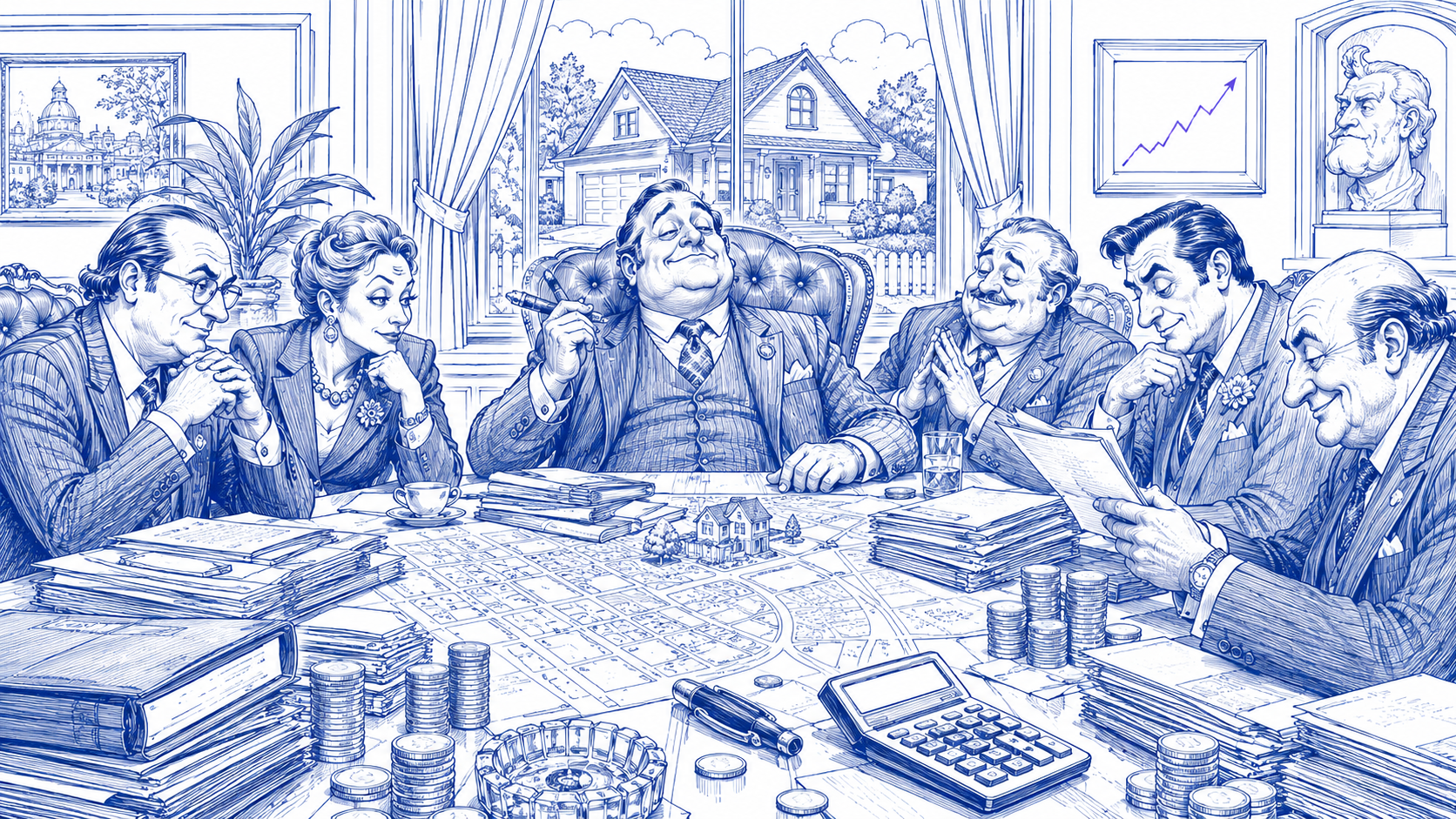
Picture a long table in a dimly lit back room. Around it sit the bosses of K Council. Not real Mafia bosses, of course. This is a story. A satire. A warning wrapped in a parable.
But the feeling for the ratepayer can be much the same.
The first boss opens the meeting.
“How much do we want to spend this year?”
Not how much can the community afford.
Not what services are essential.
Not whether the average household is already being belted by mortgages, insurance, groceries, petrol, land tax, power bills and every other charge under the sun.
Just this:
“How much do we want to spend?”
And then the list begins.
More programs.
More departments.
More community plans.
More consultants.
More strategies.
More slogans.
More things that sound noble on a glossy brochure but somehow still leave the footpaths cracked, the roads patched, the drains blocked and the bins late.
Local government was once understood by ordinary people as being about roads, rates, rubbish and recreation.
That was the deal.
Collect the bins.
Fix the roads.
Maintain the parks.
Run the libraries, pools and basic community facilities.
Keep the municipality functioning.
But over time, many councils have drifted well beyond that basic role. They now behave like small parliaments, full of grand statements, social programs, policy positions and expensive projects that ratepayers are simply expected to fund.
And when the bill comes due, it does not go to some magic money tree.
It goes to you.
In Victoria, councils work out the rate revenue they require and then spread that burden across rateable properties. Local Government Victoria explains that the total rate revenue required is divided across the total value of properties in the municipality to establish the “rate in the dollar”, which is then applied to each property’s value.¹
That is the bit many property owners miss.
The valuation is only one part of the equation.
The other part is the rate in the dollar.
So if the market falls, and property values across the municipality fall with it, that does not mean council suddenly says:
“Well, everyone’s property is worth less, so we will spend less and take less.”
That is not how the machine thinks.
The machine says:
“We still need the money.”
Then it adjusts the rate in the dollar.
If the total valuation base falls, but the council still wants the same amount of revenue, the rate in the dollar can be adjusted so the money still comes in.
Different year.
Different valuation.
Same appetite.
Possibly even a larger bill.
That is why a falling market does not automatically save the ratepayer. It may simply change the maths used to get to the same result.
The council does not start with your household budget.
It starts with its own.
You may be tightening your belt.
Council may be loosening theirs.
You may be looking at your mortgage and wondering how much more you can carry.
Council may be looking at another strategy document, another program, another department, another community initiative, another capital works project, another grant-dependent scheme that still needs ratepayer money to prop it up.
Then comes the next line in the budget meeting.
“How much will we receive from the State Government?”
“How much will we receive from the Federal Government?”
“How much grant money is coming in?”
And once all of that is counted, they look at the gap.
That gap becomes your problem.
It is dressed up in careful language.
Revenue requirement.
General rates.
Municipal charge.
Service charge.
Waste charge.
Fire services levy or its replacement equivalent.
Differential rates.
Budget pressures.
Infrastructure renewal.
Community expectations.
But at the end of the day, the ratepayer gets the envelope, or the email, or the online notice.
And the message is always the same:
Pay.
This is the part that frustrates property owners.
If you ran your household or business this way, you would be in trouble.
You do not sit at the kitchen table, decide you want to spend whatever you like, then send your neighbours an invoice for the shortfall.
But councils can do something close to that because they have a statutory rating system behind them.
They can declare rates and charges on rateable land under the Local Government Act 1989 (Vic), including general rates, municipal charges, service rates and charges, and special rates and charges.²
That does not mean every council decision is wrong.
It does not mean every service is wasteful.
It does not mean every councillor or council officer is sitting there rubbing their hands together like a movie villain.
But it does mean the system is built to protect council revenue far more effectively than it protects household budgets.
There is a Victorian rate cap system, but even that is not the same as saying your individual rates bill cannot rise. The Essential Services Commission states that the average council rate rise for 2026 to 2027 is capped at 2.75 per cent, but rate caps apply to average rates, not necessarily to every individual property owner’s bill.³
That distinction matters.
Your bill can move differently depending on your property valuation, your rating category, waste charges, fixed charges, differential rates, and other levies or charges.
So when someone says, “rates are capped”, the proper response is:
“Capped how, and for whom?”
Because your own bill is what matters.
Not the average.
Not the press release.
Not the mayor’s quote in the budget papers.
Your bill.
Your bank account.
Your household.
This is where the fictional K Council boss stands up at the end of the meeting.
He straightens his tie.
He looks around the room.
He says:
“The people are worried their property values are falling.”
Someone asks:
“Does that mean we collect less?”
The room goes quiet.
Then everyone laughs.
“No,” says the boss.
“We just change the rate in the dollar.”
And that is the point.
If property values fall across the board, the council’s spending habits do not automatically fall with them.
A lower valuation does not necessarily mean a lower rates bill.
A falling market does not necessarily mean relief.
The ratepayer is still the easiest target in the room.
The homeowner cannot move the land.
The council knows where the property is.
The valuation system knows what it says the property is worth.
The budget says what council wants to spend.
The rate in the dollar does the rest.
That is why property owners should read council budgets, not just rate notices.
Look at what your council is actually spending money on.
Look at what it calls “essential”.
Look at what has been shifted into local government that may properly belong with State or Federal Government.
Look at whether council is focused on core services, or whether it has become distracted by political theatre and social policy that ordinary ratepayers never asked to fund through their property.
Because when the market turns down, the council machine does not turn down with it.
It recalculates.
It rephrases.
It rebadges.
Then it sends the bill.
So, will your council rates go down if the property market falls?
Do not count on it.
The valuation might change.
The wording might change.
The explanation might change.
But the appetite for your money rarely does.
And K Council?
K Council is already measuring the rate in the dollar.
Sources and factual notes:
Local Government Victoria explains that council rates are calculated by applying the rate in the dollar to the property valuation, and that councils determine the total rate revenue required before spreading it across the total value of properties in the municipality.
Section 155 of the Local Government Act 1989 (Vic) allows councils to declare rates and charges on rateable land, including general rates, municipal charges, service rates and charges, and special rates and charges.
The Essential Services Commission states that the Victorian council rate cap for the 2026 to 2027 financial year is 2.75 per cent for average council rate rises.