Apartment Car Parks and Storage Lots in Victoria | What Agents Should Check
/ David Dawn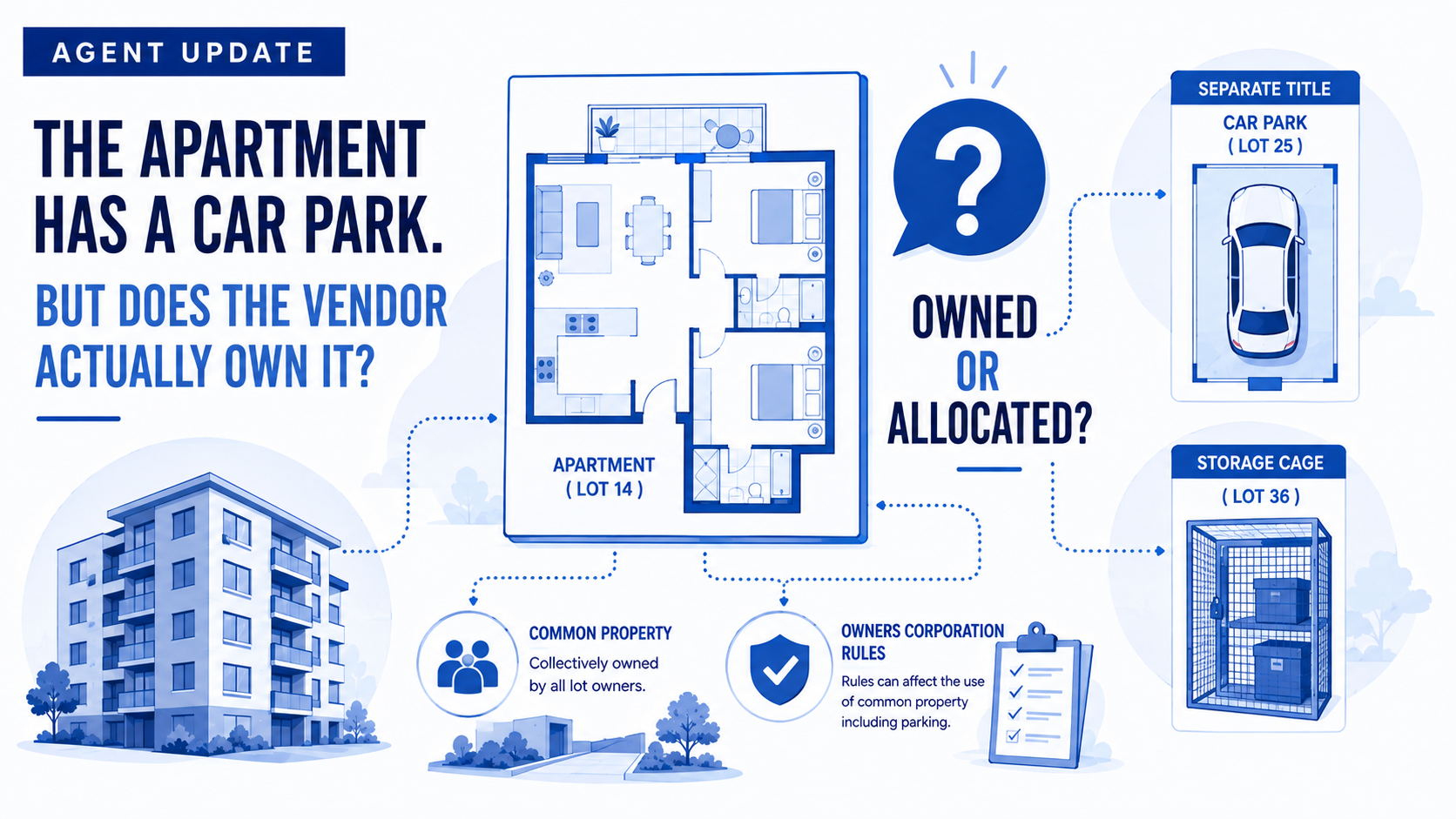
The Apartment Has a Car Park. But Does the Vendor Actually Own It?
It is one of the most familiar lines in apartment advertising: 2 bedrooms. 2 bathrooms. 1 car space.
The vendor may have used the same parking space for ten years and their apartment number may even be painted on the wall.
But before advertising the property as including a car space, there is one useful question to ask.
Start with the plan of subdivision
The plan of subdivision identifies the individual lots and common property within the development.
The car park may be:
(a) part of the apartment lot;
(b) a separate titled lot;
(c) common property; or
(d) subject to an Owners Corporation arrangement.
The physical appearance of the building does not answer that question.
It may be on the same title
In some developments the apartment and car space form part of the same lot.
If so, the boundaries shown on the plan will generally identify what forms part of that lot.
It may have its own title
A car park can also be a separate lot with its own title.
That means the contract may need to identify both the apartment title and the separate car park title.
What if it is common property?
Common property consists of parts of the development that are not individual lots on the plan of subdivision.
It is collectively owned by the lot owners rather than belonging exclusively to one apartment owner.
A vendor may therefore have the use of a particular parking space without owning that piece of land as a separate lot.
Owners Corporation rules may matter
Owners Corporations can make rules concerning the use of common property, including rules dealing with vehicles and parking.
The vendor's practical use of a parking space may therefore depend on both the plan of subdivision and the Owners Corporation arrangements applying to the development.
A painted apartment number does not prove ownership
If the wall says “Apartment 14”, that may be good evidence of how the parking has historically been used.
It is not necessarily evidence that Apartment 14 owns the land.
Storage cages have the same problem
Storage areas can be included in the apartment lot, separately titled, common property or subject to another Owners Corporation arrangement.
If the advertisement says the apartment includes storage, the basis for that statement should be understood.
Multiple Owners Corporations can complicate the position
Larger developments may contain several Owners Corporations dealing with different buildings, facilities, parking areas or groups of lots.
That is another reason not to assume ownership simply from the physical layout of the property.
Be careful how the property is described
These descriptions can have very different meanings:
“Titled car space.”
“Separate car park on title.”
“Allocated basement parking.”
“Exclusive-use parking.”
“Parking available.”
The advertising should reflect what the title, plan and Owners Corporation documents actually establish.
What should agents check?
1. Is the car park contained within the apartment lot?
2. Is there a separate car park title?
3. Has any separate title been included in the contract instructions?
4. Is the parking space actually common property?
5. Do Owners Corporation rules affect the parking arrangement?
6. How is the storage cage or storage area held?
7. Are there other areas or fixtures being advertised that need checking?
Further information
Land Use Victoria – Plans of subdivision and consolidation
Consumer Affairs Victoria – Owners Corporation definitions
Consumer Affairs Victoria – Owners Corporation rules
Consumer Affairs Victoria – Multiple Owners Corporations
Not sure what is actually included in the sale?
Send us the title and plan before the advertising goes live. We can check the car park, storage lot and other relevant property interests before they become part of the negotiation.
David Dawn
Licensed Conveyancer
Victorian Property Settlements
Post Office Box 11220
Frankston, Victoria 3199
David@quick32.com