Windfall Gains Tax and Rezoned Land in Victoria | What Agents Should Know
/ David Dawn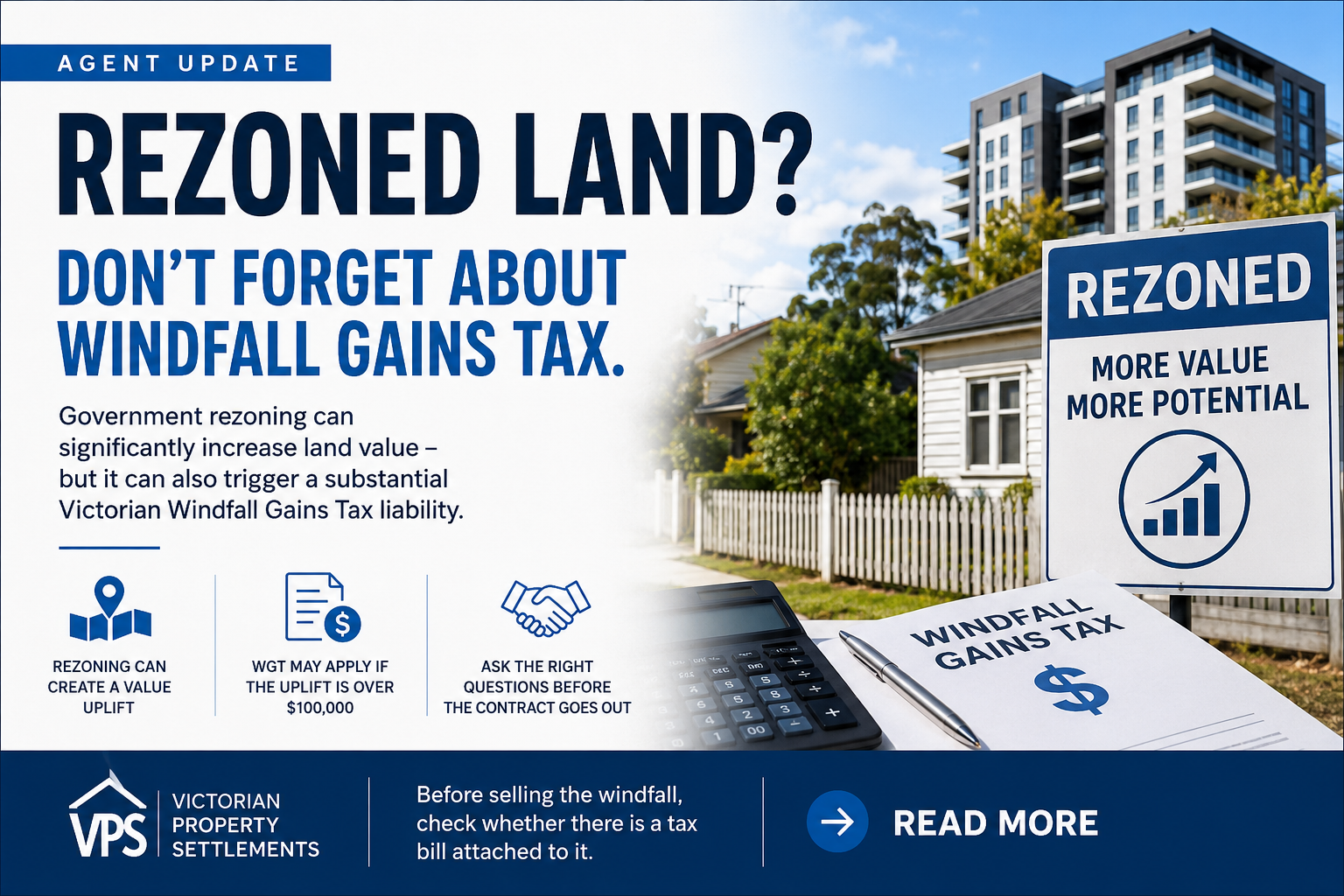
Your Vendor’s Land Has Been Rezoned. Has Anyone Asked About Windfall Gains Tax?
For many Victorian property owners, rezoning sounds like winning the lottery.
A conventional residential property may suddenly attract interest from developers. A block near a railway station may become part of an activity centre. The vendor starts hearing phrases such as higher density, development potential and your land may now be worth more.
All of that may be good news. But there is another question that should be asked before the property is marketed or the sale price is agreed:
Because the same planning change that increases the apparent value of the property may also create a substantial Victorian tax issue.
What is Windfall Gains Tax?
Victoria’s Windfall Gains Tax has applied since 1 July 2023. Broadly, it applies where a qualifying government rezoning increases the value of land by more than $100,000.
The State Revenue Office describes the increase as the taxable value uplift. It is calculated using the difference between the capital improved value of the land before and after the rezoning, with the relevant valuations determined by the Valuer-General Victoria.
Importantly, the tax is triggered by the rezoning. It is not a tax created simply because the owner later decides to sell or develop the land.
How significant can the tax be?
The current tax rates are substantial:
Value uplift between $100,000 and $500,000:
62.5% of the uplift above the first $100,000.
Value uplift of $500,000 or more:
50% of the entire taxable value uplift.
For example, the State Revenue Office gives the example of a $600,000 taxable value uplift producing a $300,000 Windfall Gains Tax liability.
This is why the issue should not be left until settlement.
But not every rezoned property will pay the tax
This is equally important.
A rezoning does not automatically mean Windfall Gains Tax is payable.
There are a number of exemptions and exclusions. One particularly important exemption applies to up to 2 hectares of qualifying residential land owned by the same owner or group for a particular planning scheme amendment.
The residential exemption can include land containing a home, land where a home is being constructed or renovated, and certain primary production land containing a home.
Vacant land is not covered by that residential land exemption.
The important question is whether the issue has been identified and checked before assumptions about value are built into the campaign.
Why this is particularly relevant now
Victoria is implementing major planning changes around train and tram activity centres.
Plans for 25 Stage 1 activity centres were finalised on 31 March 2026, followed by another 23 Stage 2 centres on 22 July 2026.
The broader program is intended to facilitate substantially more housing around public transport, employment and services.
That means more owners are going to hear that their properties may now have increased development potential.
For some properties, that may result in developers making approaches or vendors substantially increasing their expectations about price.
Ask the vendor what they have already received
When a property has been affected by a significant planning change, ask the vendor whether they have received correspondence from:
(a) the State Revenue Office;
(b) the Valuer-General Victoria;
(c) the Victorian Government;
(d) the local council;
(e) a town planner;
(f) an accountant or taxation adviser; or
(g) a developer who has approached them about the property.
Do not assume the vendor will automatically appreciate the significance of an assessment or notice they received months earlier.
The contract issue agents need to know about
There is another important reason to identify Windfall Gains Tax before the contract is signed.
From 1 January 2024, a vendor cannot pass a known Windfall Gains Tax liability directly to a purchaser under a Contract of Sale or option agreement.
A known liability is one that has already been assessed and served before the contract is entered into.
A clause requiring the purchaser to pay all or part of that known liability is void, and including such a clause is an offence.
The vendor can, however, take the cost of the tax into account when determining the overall sale price.
A simple example
Imagine an older property near a railway station.
Before a planning change, the vendor believes it is worth $1.2 million.
Following rezoning, developers begin discussing prices closer to $1.8 million.
Everyone is understandably focused on the apparent $600,000 increase in value.
But if the rezoning also produced a substantial taxable value uplift and no exemption applies, the vendor needs to understand that position before deciding what price represents an acceptable sale.
The headline increase in value is not necessarily the amount the vendor ultimately keeps.
Deferring the tax does not make it disappear
In qualifying circumstances, payment of Windfall Gains Tax can be deferred.
The State Revenue Office currently permits deferral until the next relevant dutiable transaction or relevant acquisition, or 30 years after the rezoning, whichever occurs first.
Interest accrues while the liability is deferred.
That means a vendor may have deferred the liability when the rezoning occurred, only for it to become immediately relevant when the property is later sold.
What should agents do?
When taking instructions on a property affected by recent rezoning, ask three simple questions:
1. Has the property recently been rezoned?
2. Has the vendor received any Windfall Gains Tax assessment or SRO correspondence?
3. Has the vendor obtained advice about the tax position before setting the sale price?
If the answer to any of those questions is uncertain, refer the vendor to us before the Contract of Sale is issued.
We can identify the issue early and, where necessary, recommend appropriate taxation or planning advice before the transaction gets ahead of the paperwork.
Further information
State Revenue Office Victoria – Understanding Windfall Gains Tax
State Revenue Office Victoria – Buying and selling land subject to Windfall Gains Tax
State Revenue Office Victoria – Windfall Gains Tax exemptions and exclusions
Planning Victoria – Train and Tram Zone Activity Centres
Selling property affected by rezoning?
Send the property details to us before the contract goes out. We would much rather identify the issue before the purchaser signs than try to untangle it afterwards.
David Dawn
Licensed Conveyancer
Victorian Property Settlements
Post Office Box 11220
Frankston, Victoria 3199
David@quick32.com